
A bank reconciliation can balance while tenant deposit records remain wrong. The bank may agree to recorded cash even though a refund was charged to the wrong liability account, a resident balance was omitted or a transfer was assigned to the wrong property.
Use a documented reconciliation to connect the cash to the obligation it supports. This guide explains accounting review; it does not establish legal compliance or authorize moving tenant money. Confirm who holds the funds and which property, entity and legal requirements apply before beginning.
Start with one date and a defined population
Gather the deposit bank statement, reconciliation, cash-account ledger, deposit-liability ledger and tenant deposit detail as of the same cutoff. Include approved refunds, transfers, move-outs and any separate advance-rent or interest records relevant to the account.
Check report filters. Active residents alone may omit former residents with unresolved deposits. A portfolio total may include properties that do not use the bank account under review. Keep amounts held by another owner or custodian separately identified rather than assuming the management company holds every tenant’s deposit.
Review cash and liabilities as connected comparisons
| Comparison | Purpose | Common follow-up |
|---|---|---|
| Adjusted bank to ledger cash | Explain timing and recording differences in cash | Outstanding refunds, deposits in transit, fees, transfers and duplicate entries |
| Deposit liability to tenant detail | Explain the recorded obligation by resident | Missing residents, misapplied refunds, transfers and unsupported adjustments |
| Cash held to obligations supported | Identify an unexplained funding or classification difference | Different account populations, advance rent, interest, other held funds or a shortfall requiring escalation |
The totals only become comparable after you define what belongs in each. An account that holds permitted categories other than security deposits needs a supported bridge for those categories. Do not label every difference a shortage or assume different totals are harmless.
A fictional example: the bank balances, but tenant detail does not
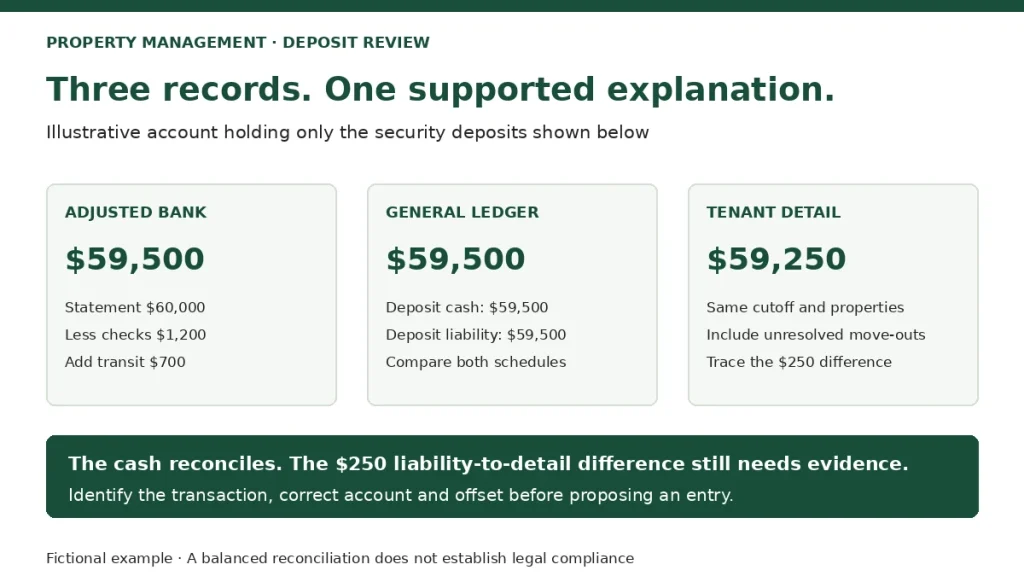
Assume this account holds only the security deposits in the example, with no other supported categories. All figures are fictional and do not describe a Greenkey client.
| Item | Amount |
|---|---|
| Bank statement balance | $60,000 |
| Less outstanding refund checks already recorded | ($1,200) |
| Add deposit in transit already recorded | $700 |
| Adjusted bank balance | $59,500 |
| General-ledger deposit cash | $59,500 |
| General-ledger deposit liability | $59,500 |
| Tenant deposit detail | $59,250 |
| Liability above tenant detail: investigate | $250 |
The cash reconciliation works: $60,000 − $1,200 + $700 = $59,500. The $250 liability-to-detail difference remains unresolved. It might reflect a missing resident, a cutoff difference or a misclassified transaction. Those are possibilities to test, not established causes.
Begin with the last reconciled period and compare activity forward. If you find a $250 item, retain its resident, transaction date, ledger accounts, payment status and source document. A matching amount alone does not prove it explains the difference.
Follow a refund through every record
Trace one refund from the approved resident disposition to the tenant ledger, payable or clearing account, bank transaction and liability entry. A cleared check proves payment from a bank account; it does not prove the correct liability account was relieved.
Also inspect deposits received near month-end, transfers between units or properties, interest where applicable, stale refunds and manual journal entries. Keep timing items separate from posting errors. Avoid counting a refund twice because it appears on both an accounts-payable report and a deposit report.
Use an exception log instead of a balancing entry
| Field | What to record |
|---|---|
| Period and population | As-of date, bank account, entity and included properties |
| Difference | Amount, direction and the two records being compared |
| Evidence | Resident or transaction reference and supporting documents |
| Cause and action | Confirmed cause, proposed correction and required approvals |
| Follow-up | Responsible owner, review date and resolution evidence |
Do not post an unexplained amount to income or expense merely to force agreement. Confirm the transaction, correct account and offset first. Deposits held for tenants are not ordinary management-fee revenue simply because cash is in a bank account. Escalate a suspected shortage or unsupported movement promptly to the responsible owner and appropriate professional.
Keep legal requirements separate from the accounting checklist
Florida’s residential deposit statute addresses permitted ways to hold funds, notices, claims, returns and transfers; it also contains exceptions and special applicability provisions. The correct process depends on the rental arrangement and applicable program. Use the current statute and appropriate legal guidance for deadlines, notices and fund handling. A balanced spreadsheet does not demonstrate compliance.
For the wider close, use the property-management month-end close checklist. To keep deposits, property performance and company cash distinct, read the NOI and cash-movement guide and management-company profit-per-door article.
Explore Greenkey’s property-management accounting support if you need a more dependable close. Tenant-fund custody, regulated trust accounting and specialized compliance are not automatically included; any related work must be explicitly scoped.
Source and review date
Reviewed November 17, 2026. Legal context: Florida Statutes section 83.49, including its applicability provisions. The comparisons, exception log and fictional example above are educational accounting guidance. Requirements outside Florida may differ. Greenkey does not provide payroll processing or income-tax preparation.
Leave a Reply