
A funded-loan report, a bank deposit and the revenue in your Profit & Loss can describe different parts of the same transaction. Treating them as interchangeable makes it harder to explain a strong production month with weak cash receipts—or a large deposit that includes older commissions.
This checklist is for the brokerage’s company books. It is an educational workflow, not a filing calendar or a promise about Greenkey’s contracted close schedule. Loan principal is not brokerage commission revenue.
1. Agree on the cutoff and gather the source reports
Use the same month-end date for your trial balance, bank reconciliation and commission detail. Export loan activity from your loan origination system, commission statements, receivable detail, bank statements and support for approved company expenses. Keep the original exports with the date, filters and responsible owner.
Identify late changes before replacing an export. A refreshed loan report may include a cancellation, correction or status change that was not present when accounting first reviewed the month.
2. Reconcile earned commissions to receipts and receivables
Match loan identifiers, the supported commission amount, the earning event under your accounting policy, the receipt date and any approved adjustment. Funding status alone does not establish every accounting conclusion. Your accountant should confirm recognition and classification based on the arrangement and accounting basis.
Review unmatched items in both directions: a commission on the activity report without a corresponding recorded amount, and a bank receipt without identified support. Document reversals, chargebacks, corrections and partial payments separately rather than hiding them in a net total.
A fictional commission bridge
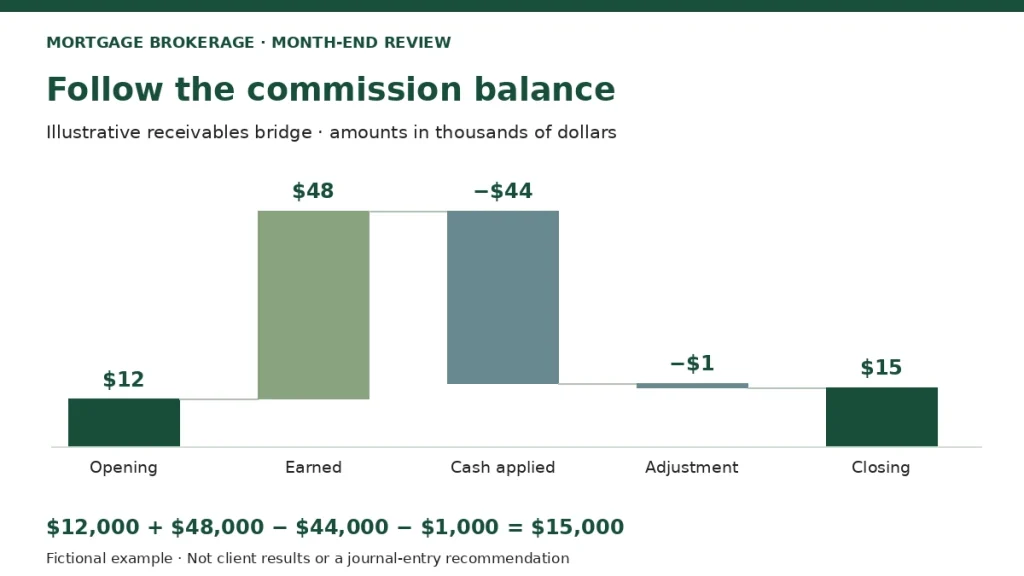
The example below assumes the listed commissions have been earned under the company’s policy. It illustrates an accrual-basis receivable roll-forward, not a client result or a journal-entry recommendation.
| Item | Amount | Support to retain |
|---|---|---|
| Opening commission receivables | $12,000 | Prior close’s approved receivable listing |
| Add earned commissions this month | $48,000 | Loan-level commission statements and earning support |
| Less cash applied to commissions | ($44,000) | Bank receipts matched to individual receivables |
| Less supported adjustment | ($1,000) | Approved correction or chargeback evidence |
| Closing commission receivables | $15,000 | Loan-level unpaid amounts agreeing to the ledger |
The bridge is $12,000 + $48,000 − $44,000 − $1,000 = $15,000. A mismatch means you need to identify the underlying items. It does not justify posting a balancing entry without support.
3. Reconcile company cash and Balance Sheet accounts
Reconcile agreed bank and credit-card accounts, then review receivables, payables, loans, prepayments and other material balances against their schedules. Separate company revenue from owner contributions, transfers and loan proceeds. Reconcile gross receipts and associated fees with their source records; a net deposit may require more than one accounting line.
If your business holds money for others, keep its legal ownership, records and controls distinct from the company’s operating cash. Any regulated custody or trust-account work requires its own applicable requirements and engagement scope.
4. Review costs, exceptions and the financial story
Compare the month with the prior month and budget, using consistent definitions. Investigate unusual commission expense, software costs, financing charges and unsupported balances. Obtain the appropriate review of compensation-related accounting; this checklist does not offer payroll processing.
Then explain the relationship between production, earned revenue and cash. For example, a large closing receivable may explain cash timing without proving that expenses are under control. Pair this close with the mortgage broker break-even guide when evaluating your operating cost base.
5. Finish with a short close packet
| Deliverable | Review question | Owner to assign |
|---|---|---|
| Reconciled statements and schedules | Do ending balances agree to retained evidence? | Accounting preparer and reviewer |
| Loan-to-commission reconciliation | Are unmatched loans, receipts and adjustments explained? | Operations and accounting |
| Open-items list | Does each issue have an amount, cause to investigate and next action? | Named issue owner |
| Management summary | What changed in profit, cash and outstanding receivables? | Financial reviewer and leadership |
A useful close packet makes unresolved items visible. Record the period, amount, source, owner and next review date. Retain review sign-off and document later corrections so next month’s opening balance can be traced.
How this supports Mortgage Call Report preparation
NMLS distinguishes the company-level Financial Condition component from the Residential Mortgage Loan Activity component, which includes state-level loan activity. Supported books and loan records provide inputs; completing a bookkeeping checklist does not itself establish a complete or compliant filing. Confirm your company’s current reporting obligations and field definitions with the official instructions and responsible preparer.
Continue with the MCR financial-records readiness guide for the reporting handoff, or the commission reconciliation guide for a deeper loan-level review. For recurring company bookkeeping, see Greenkey’s mortgage brokerage accounting support.
Source and review date
Reviewed November 17, 2026. Regulatory context: NMLS Mortgage Call Report FV7 User Guide. The workflow, fictional figures and suggested handoff above are Greenkey educational examples. Confirm current requirements before filing. Greenkey does not provide payroll processing or income-tax preparation.
Leave a Reply